 Give Us A Call! 702-276-6534
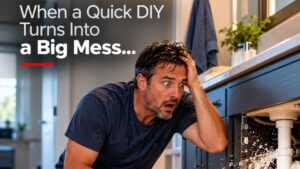
There’s a certain satisfaction that comes from fixing something around the house yourself.
A dripping faucet? Grab a wrench. Slow drain? Head to the hardware store. Leaking pipe under the sink? Surely there’s a five-minute video online showing exactly how to fix it.
Sometimes that works perfectly.
Other times, a $20 DIY plumbing repair turns into water spraying across the bathroom at 9:30 on a Sunday night.
For homeowners in Henderson and the Las Vegas Valley, knowing which plumbing projects are reasonable DIY jobs — and which ones are better left to a professional — can save time, frustration, and potentially a lot of money.
Some Plumbing Repairs Really Are DIY-Friendly
Not every plumbing problem requires calling a plumber.
If you’re comfortable with basic home maintenance, there are several relatively simple tasks many homeowners can handle themselves.
These might include replacing a toilet flapper, cleaning a faucet aerator, unclogging a minor sink blockage, replacing a showerhead, or tightening a loose fixture.
The key is understanding the difference between basic maintenance and a repair that can affect your home’s water or drain system.
Once you’re disconnecting pipes, replacing valves, working on a water heater, or opening walls, the consequences of making a mistake become much larger.
The Most Important DIY Plumbing Rule: Know Where Your Water Shutoff Is
Before touching almost any plumbing connection, you should know how to stop the water.
Many fixtures have individual shutoff valves located nearby.
But every homeowner should also know where the home’s main water shutoff is located and how to operate it.
Why?
Because a plumbing repair can go from completely normal to very wet in seconds.
A fitting can break. An old valve can fail. A pipe can crack. A connection that looked perfectly fine can suddenly start spraying water.
That’s not the moment you want to begin searching for your main shutoff.
Old Plumbing Doesn’t Always Cooperate
One of the biggest surprises with DIY plumbing repairs is that the component you’re trying to replace may not be the only problem.
You might attempt to replace a faucet and discover that the shutoff valve underneath the sink no longer closes completely.
You turn the valve a little harder.
Now the valve starts leaking.
Suddenly your faucet replacement has become a valve replacement too.
Older plumbing components can become corroded, brittle, or difficult to move. Sometimes disturbing one component exposes a problem with another.
That’s where seemingly simple projects can quickly grow.
Be Careful With Drain-Cleaning Chemicals
A slow drain is one of the most common reasons homeowners attempt a DIY plumbing fix.
The first instinct is often to pour a chemical drain cleaner down the pipe.
But repeated use of harsh chemicals isn’t necessarily the best solution.
If a drain repeatedly slows or backs up, there may be a larger blockage or another problem within the drain system.
The chemical might temporarily improve flow without addressing the underlying issue.
And if you eventually call a plumber, tell them what products you’ve already put into the drain. A technician working on the line needs to know if potentially hazardous chemicals may still be present.
Tightening Something More Isn’t Always Better
Plumbing fittings need to be secure.
That doesn’t mean they should be tightened with every ounce of strength you have.
Overtightening certain plumbing components can damage threads, crack fittings, distort seals, or create leaks.
This happens frequently when homeowners see a small drip and assume another quarter-turn will solve everything.
Sometimes it does.
Sometimes that quarter-turn turns a small leak into a broken fitting.
If something continues leaking after being properly installed, the problem may be the seal, fitting, threads, or component itself — not a lack of force.
A Small Leak Can Create a Big Repair
Water has an annoying ability to travel.
A leak underneath a sink may run along a pipe before dripping somewhere else. Water behind a wall can travel downward and appear far from the actual source.
That means the visible water isn’t always where the plumbing failure occurred.
It’s also why seemingly minor leaks deserve attention.
Water can damage cabinets, drywall, flooring, insulation, and other building materials if it continues long enough.
Fixing the plumbing is one thing.
Repairing everything damaged by the water can become the expensive part.
Water Heater DIY Repairs Deserve Extra Caution
A water heater combines plumbing with either electricity or gas, depending on the system.
That’s considerably different from replacing a faucet aerator.
Improper water-heater work can create risks involving water damage, burns, electrical systems, combustion, venting, gas connections, and pressure.
Water heaters also incorporate safety components that shouldn’t be modified or bypassed.
If you’re dealing with leaking connections, unusual noises, inconsistent hot water, installation issues, gas components, electrical components, or pressure-related problems, professional service is generally the safer approach.
Southern Nevada Plumbing Has Its Own Challenges
Homes in Henderson and the Las Vegas Valley also deal with our region’s hard water.
Mineral buildup can make plumbing components more difficult to remove and can contribute to scale around fixtures, valves, faucets, and water-heater components.
A connection that looks simple in a tutorial filmed somewhere else may be much more stubborn after years of exposure to mineral-rich Southern Nevada water.
That’s another reason it’s important not to force a plumbing component that doesn’t want to move.
When Should You Stop a DIY Plumbing Repair?
One of the best DIY skills is knowing when to stop.
It’s probably time to call a professional if:
* You can’t completely shut off the water
* A valve starts leaking while you’re working
* The repair requires opening a wall
* You discover significant corrosion
* Water continues leaking after the repair
* Multiple drains are backing up
* You suspect a hidden or slab leak
* The problem involves a gas water heater
* You aren’t sure you’ve identified the actual cause
* The project has grown beyond what you originally planned
There’s nothing wrong with deciding a repair has moved beyond your comfort level.
The expensive mistake is continuing after you’re no longer sure what you’re doing.
The Internet Doesn’t Know What’s Behind Your Wall
Online videos are fantastic for learning basic home maintenance.
But the person in the video isn’t standing in your house.
They don’t know the age of your plumbing, what materials were used, whether previous repairs were done correctly, or what’s happening inside the wall.
Two plumbing problems that look identical from the outside can have completely different causes.
Use online information to become a more informed homeowner — not as proof that every plumbing repair should be attempted yourself.
Know When to Call Pipe Pros
We’re not going to tell you that every dripping faucet requires a plumber.
But if your Saturday morning DIY project suddenly involves water where water shouldn’t be, it’s probably time to put down the wrench.
Pipe Pros Plumbing & Mechanical serves homeowners throughout Henderson and the Las Vegas Valley with professional plumbing diagnostics and repairs.
Whether your plumbing problem started on its own or your quick DIY fix became a little more complicated than expected, we’ll help figure out what happened and get it repaired correctly.
DIY didn’t go according to plan? Don’t turn a small problem into a bigger one. Call Pipe Pros.
Disclaimer: This article was created by Two Four Media for general informational purposes only and is not intended as professional plumbing advice. Plumbing systems and situations can vary. For questions about your specific plumbing needs, diagnosis, repairs, or service, please contact Pipe Pros directly.