 Give Us A Call! 702-276-6534

A sewer-like smell inside your home is hard to ignore—and you shouldn’t have to live with it.
Sometimes the source is surprisingly simple, such as a dry drain in a guest bathroom that hasn’t been used in months. Other times, persistent sewer odors can point to a plumbing problem that deserves professional attention.
For homeowners throughout Las Vegas, Summerlin, Spring Valley, Enterprise, Mountains Edge, Southern Highlands, Centennial Hills, and the surrounding valley, here are some of the common places to start looking when an unpleasant drain or sewer smell appears indoors.
Start With the Room Where You Notice the Smell
Before assuming there’s a major sewer-line problem, try to narrow down where the odor is strongest.
Is it coming from:
- A bathroom sink?
- The shower or tub?
- A floor drain?
- The kitchen?
- A laundry room?
- Around the base of a toilet?
- Several drains throughout the house?
A smell isolated to one drain is a different situation from an odor appearing throughout multiple rooms.
Also pay attention to when it happens. An odor that appears after using a particular fixture can provide a useful clue.
A Dry P-Trap Is One of the Simplest Possibilities
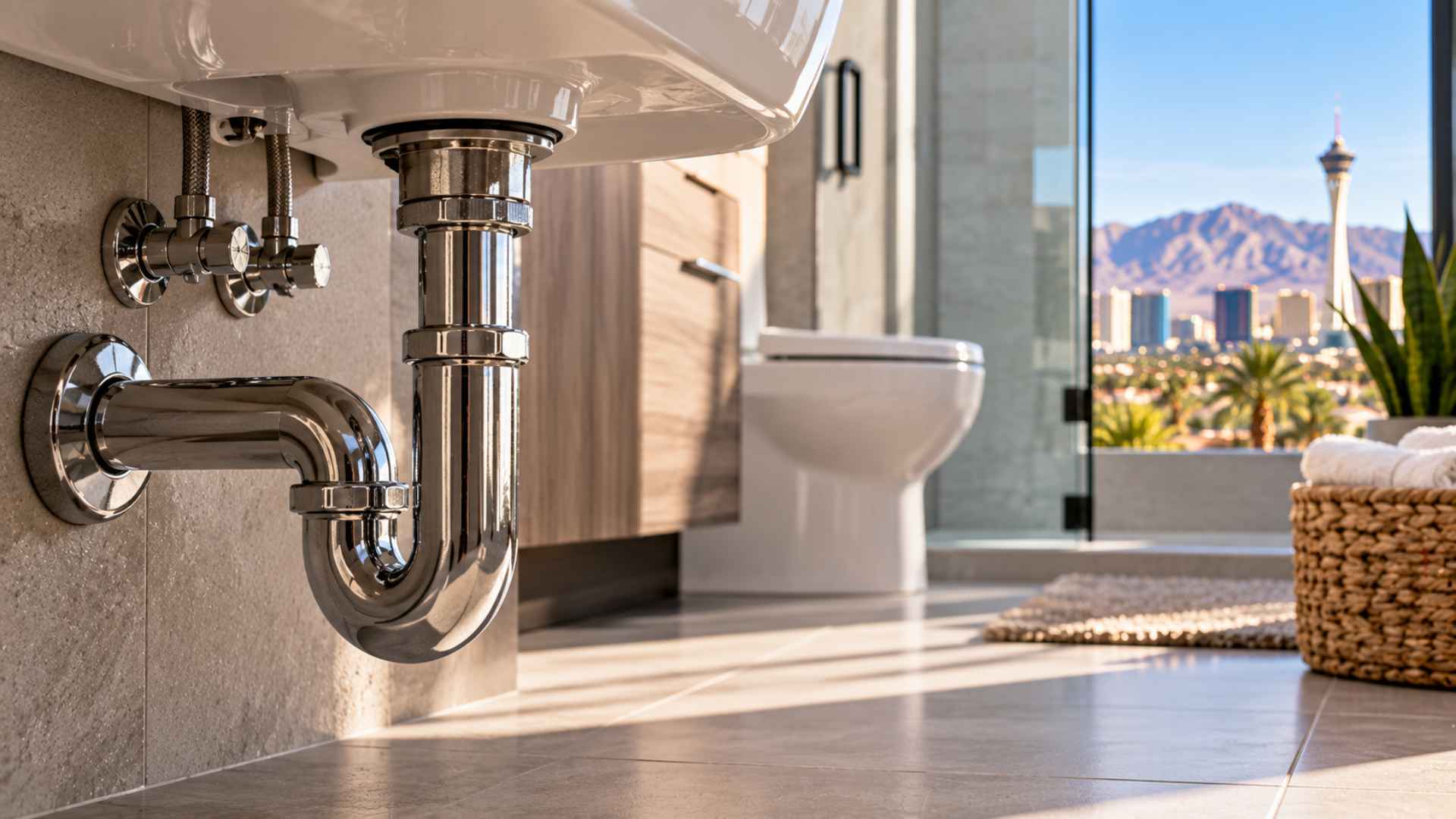
Under many sinks and other plumbing fixtures is a curved section of pipe called a P-trap.
Its job isn’t only to move wastewater. The trap is designed to hold a small amount of water that creates a barrier between your home and gases in the drainage system.
If that water evaporates, the barrier disappears.
This can happen in fixtures that aren’t used very often, including:
- Guest bathrooms
- Spare showers
- Floor drains
- Utility sinks
- Seasonal or rarely used areas of the home
In Las Vegas, where our climate is exceptionally dry, evaporation is something homeowners are already accustomed to dealing with.
If an unused drain starts smelling, a dry trap is one possibility worth considering.
Drain Buildup Can Smell Like a Sewer Problem
Not every bad smell coming from a drain is actually sewer gas.
Bathroom and kitchen drains collect all kinds of material.
Hair, soap residue, skin products, food particles, grease, and other organic material can accumulate inside the drain. As that material sits, it can develop an unpleasant odor.
You may notice the smell becoming stronger when water runs through the drain.
If the odor is isolated to one sink or shower, buildup near that particular drain may be involved.
Recurring odors combined with slow drainage can also indicate that the line needs more attention than simple surface cleaning.
Check Around the Toilet
If the smell is strongest near a toilet, the source may not be the drain you initially suspected.
Toilets are sealed to the drainage system at the floor. If that seal is compromised, odors can potentially escape around the base.
Other warning signs can include:
- A toilet that rocks or moves
- Moisture around the base
- Staining near the floor
- An odor concentrated around the toilet
- Signs that the toilet isn’t securely seated
A toilet shouldn’t move when you sit on it.
If it does—or if you notice moisture along with the odor—have the installation checked.
Plumbing Vents Play an Important Role
Your home’s drainage system also needs air.
Plumbing vent pipes allow gases to exit the drainage system and help wastewater move properly through the pipes.
Problems involving the venting system can sometimes contribute to drainage symptoms or odors inside the home.
You may notice other signs at the same time, such as:
- Gurgling drains
- Toilets bubbling
- Slow drainage
- Water levels changing in traps
- Odors appearing at multiple fixtures
Venting problems aren’t something most homeowners can diagnose simply by looking down a drain.
If several fixtures are behaving strangely at the same time, it’s worth having the larger plumbing system evaluated.
A Sewer-Line Problem Can Affect Multiple Drains
One smelly bathroom sink doesn’t automatically mean you have a sewer-line problem.
Several plumbing symptoms occurring together are more concerning.
Pay attention if sewer odors are accompanied by:
- Multiple slow drains
- Repeated backups
- Toilets that gurgle
- Water backing up into a shower or tub
- Problems at the lowest drains in the house
- Recurring clogs
- Sewage appearing where it shouldn’t
These symptoms can indicate a problem farther down the drainage system rather than an isolated fixture.
At that point, repeatedly treating individual drains isn’t addressing the underlying issue.
Older Las Vegas Homes Can Have Different Plumbing Concerns
Southern Nevada is known for rapid growth, but not every Las Vegas neighborhood is new construction.
Established areas around central Las Vegas, Downtown, Charleston, Paradise, and older sections of the valley may have plumbing systems that have been in service for decades.
Age alone doesn’t mean there’s a sewer problem.
However, older drain and sewer lines can experience deterioration, shifting, root intrusion, damaged connections, or other conditions that may require inspection.
If you’ve purchased an older Las Vegas home and are experiencing recurring drain problems or persistent sewer odors, the condition of the drainage system may be worth investigating.
Tree Roots Can Create Problems Underground
It might seem strange to talk about tree roots in the desert, but Las Vegas has plenty of mature landscaping.
Roots naturally seek sources of moisture. If a sewer line has an opening, damaged joint, or crack, roots may find their way inside.
Once established, they can catch debris and restrict wastewater flow.
The homeowner may initially notice occasional slow drains or clogs before the problem becomes more significant.
Clearing a blockage may restore flow, but if damaged piping or root intrusion is responsible, identifying the underlying cause matters.
Don’t Just Cover Up a Persistent Sewer Smell
Air freshener may make the bathroom smell better temporarily, but it doesn’t tell you why the odor is there.
The same applies to repeatedly pouring products down the drain without knowing what’s causing the problem.
If an odor disappears after addressing an obvious dry drain and doesn’t return, the explanation may have been simple.
If it keeps coming back, spreads to other fixtures, or appears alongside drainage problems, it’s time to look deeper.
When Should You Call a Plumber About Sewer Odors?
Consider having your plumbing checked if:
- The sewer smell keeps returning
- Several drains smell at the same time
- Drains are also slow or backing up
- Toilets or drains are gurgling
- The smell is strongest around the base of a toilet
- You notice unexplained moisture
- Adding water to an unused drain doesn’t resolve the problem
- You suspect a sewer-line or venting issue
The important thing is identifying whether you’re dealing with one fixture or a problem affecting the larger drainage system.
Sewer or Drain Smells in Your Las Vegas Home?
From older neighborhoods near central Las Vegas to homes in Summerlin, Spring Valley, Enterprise, Mountains Edge, Southern Highlands, and Centennial Hills, plumbing systems can develop odors for many different reasons.
Pipe Pros can help identify whether the source is a drain, fixture, toilet, plumbing vent, or a problem farther down the drainage system.
Rather than repeatedly masking the smell, find out what’s causing it.
If you’re dealing with persistent sewer or drain odors, contact Pipe Pros for professional plumbing and drain service in Las Vegas and throughout Southern Nevada.
Disclaimer: This article was created by Two Four Media for general informational purposes only and is not intended as professional plumbing advice. Plumbing systems and situations can vary. For questions about your specific plumbing needs, diagnosis, repairs, or service, please contact Pipe Pros directly.